What a Mulebuy Spreadsheet entry records, and what it leaves out
We opened a single catalog entry, wrote down every field, and sorted the fields into the ones that belong on your card and the ones that are only context.
Fields on a single entry
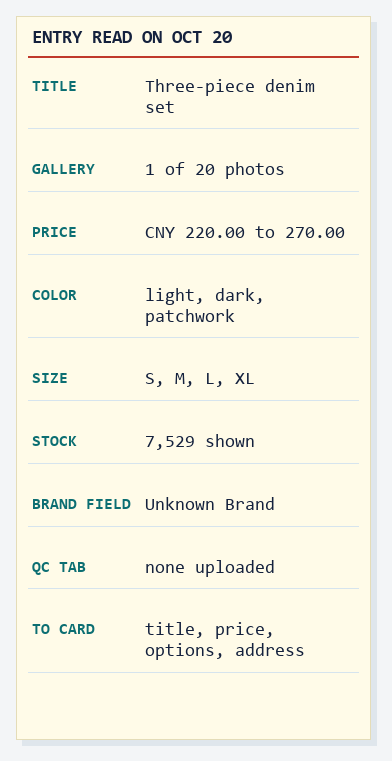
On October 20, 2026 we opened one entry on the jeans shelf, a three-piece denim set in light wash, dark wash and patchwork, and wrote down everything the page showed. It is a fair sample of what any entry gives you:
- TitleAn English description of the item, written for the catalog.
- GalleryTwenty photos, counted as 1 of 20. Most came from the seller.
- PriceCNY 220.00 to 270.00, with a rough dollar figure beside it.
- OptionsA color group and a size group, sizes S, M, L and XL.
- Stock7,529 shown as in stock.
- AttributesCategory Jeans, brand field set to Unknown Brand, status published.
- DescriptionThe seller’s own images, ending in a note headed 购前说明, a pre-purchase notice.
- QC tabEmpty: no warehouse photos uploaded yet.
Of these, four belong on your card at once: the title, the price range, the option groups and the address of the entry. The rest is context. The pre-purchase note deserves a careful read before ordering, because sellers use it for terms such as color variation or return limits.
What an entry cannot tell you
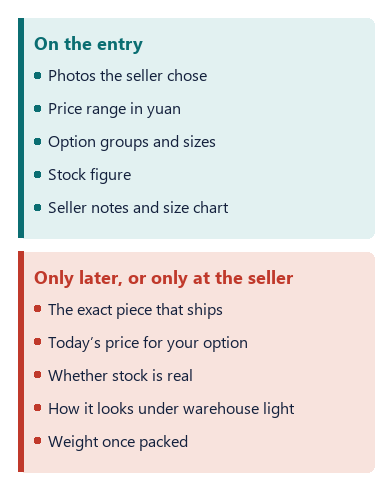
An entry is a reading of a seller's listing, and a listing is the seller's own advertisement. Several things you care about are simply not on it.
The true measurements of the piece that will be picked for you are not there; the size chart is the seller's chart, and two garments cut from the same pattern can differ by a centimeter or two. The current price is not guaranteed either. If the seller has changed it since the entry was read, the agent will ask you to pay the difference or refund it, depending on which way it moved.
Stock counts are the weakest field. Mulebuy's own FAQ, in its August 2026 copy, warned that stock shown online could not be relied on and that only the seller's confirmation decided whether an item was out of stock. Other agents say much the same in their own words.
The entry also cannot tell you how the warehouse will see the item. That comes later, in the QC photos, and it is the first moment anyone other than the seller looks at the actual piece.
How an entry goes out of date
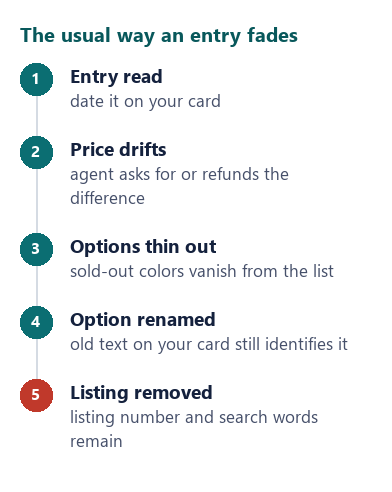
Entries age. A seller raises the price after a busy week, drops a color that sold out, renames an option, or takes the listing down altogether. The catalog entry may keep showing the old photos for a while, which is exactly why the date you read an entry belongs on your card.
The pattern is usually the same. First the price drifts, then options thin out, then the listing disappears. When it disappears, the photos and the title are often all that remain, and a search with your saved words is the way to find the same item from another shop.
Two lines on your card survive all of this: the listing number, which identifies the seller's page even when the photos are reused elsewhere, and the option text copied word for word, which lets you check a different listing against what you originally chose.
If a catalogue entry has gone stale, save its original marketplace URL and try a fresh search. Do not treat a saved price or photo as current stock.
Why keep this Spreadsheet next to your card
Why this site and not another list of finds? Mostly because of how it is kept. The shelves here point at live categories rather than frozen screenshots, so what you see is what the catalog shows today, not what it showed in spring.
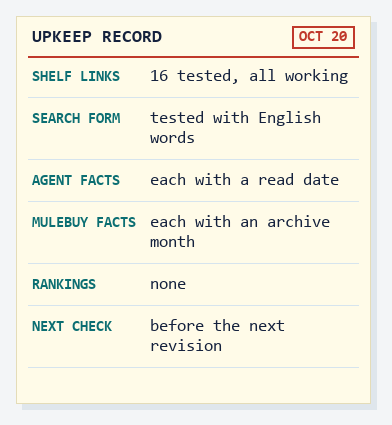
Every link was requested on October 20, 2026 and answered with a working page, and we repeat that check before each revision; dead links are the first thing a stale finds list collects. The agent facts on this site carry the date we read them. Nothing here is ranked, starred or scored.
The other reason is the record itself. Most lists of finds stop at the photo. This one is built around what happens after: the card that follows a find through the order, the warehouse and the parcel, so that the details you need for a return or a reorder are still with you weeks later.
Holding a Spreadsheet site to account, this one too
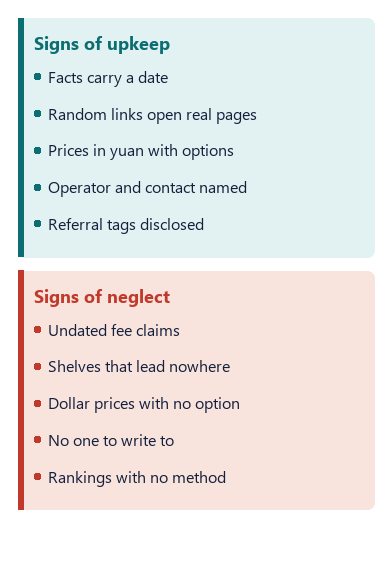
Six checks show how to judge a Spreadsheet site before you rely on it for shopping, whoever runs it:
- Dates on facts. Fees, storage days and return windows change. An undated fee claim asks for blind faith.
- Links that resolve. Click five shelves at random. If two lead nowhere, the rest of the site has probably been left alone too.
- Yuan prices and options. A useful entry shows the seller's price in yuan and the option list. A dollar figure with no option is a guess.
- A named operator and a way to write. Somebody should be responsible for the pages, and you should be able to reach them.
- Disclosed referral tags. Most sites earn from links. The honest ones say so on the page.
- No promises about authenticity or rank. No list can certify what a seller ships, and a ranking of agents with no published method is decoration.
Hold this site to the same list. The about page names how it is run and paid for, and the updates page dates every change.