From warehouse shelf to front door: parcels, weight and lines for catalog finds
The parcel is the biggest payment on most orders and the stage with the shortest deadlines. Here is what decides its price and what to record before and after it ships.
Putting a parcel together
A parcel is built from items that are already stored. You pick them on the agent's warehouse page, choose how they are packed, choose a line, and pay. The warehouse then packs, weighs and measures the real parcel.
Some items shape the whole parcel. Mulebuy's shipping page in August 2026 said an item with a mailing restriction limited the lines open to everything packed with it, and that any item with a side of 90 centimeters or more was packed on its own and could not be combined. Batteries, liquids, powders and magnets are refused by many lines, so a single bottle of perfume can narrow your choices for a box of clothes.
Packing choices change the weight. Taking items out of retail boxes reduces volume, but a pair of shoes without its box may no longer count as returnable, so decide that while the return window still matters. Reinforced packing adds weight and a fee but helps with fragile items.
On each card in the parcel, write the parcel number once it exists. That one line ties the items together for tracking and for any claim.
Actual weight, volume weight and the weight you pay for
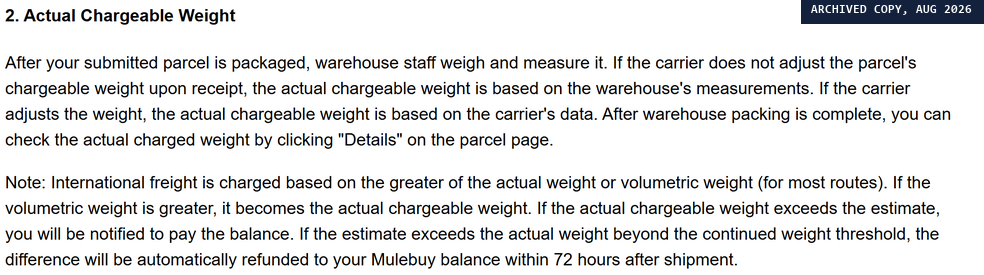
Two weights decide the price. The actual weight is the parcel on a scale, packaging included. The volume weight multiplies the box's three sides, in centimeters, then splits that by a divisor the carrier chooses; Mulebuy's weight page listed 5,000, 6,000, 7,000 or 8,000 depending on the carrier. Most lines charge whichever of the two is greater.
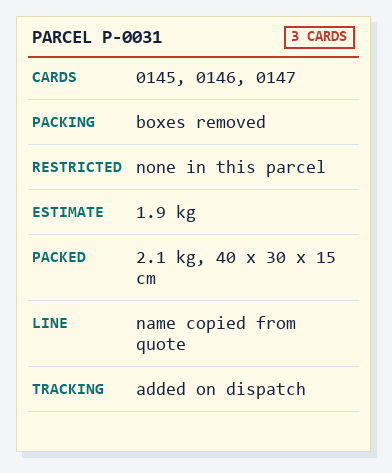
Take the example parcel on this page: 40 by 30 by 15 centimeters is 18,000 cubic centimeters. Divided by 6,000 that is 3.0 kilograms of volume weight, against 2.1 kilograms on the scale, so a line using that divisor charges for 3.0. The same box on a line that divides by 8,000 comes to 2.25 kilograms, close to the scale weight.
The page above shows how Mulebuy settled the difference between estimate and reality in August 2026. If the carrier re-weighed the parcel, the carrier's figure counted. Record the packed weight and size from the warehouse page on the parcel card; they explain the bill.
Line types and whose rules apply
A shipping line is a carrier route sold by the agent: a postal route, a courier's express network, or a line run by a logistics partner. The name on the quote matters less than two facts about it: whether import tax is included, and whose rules apply when something goes wrong.
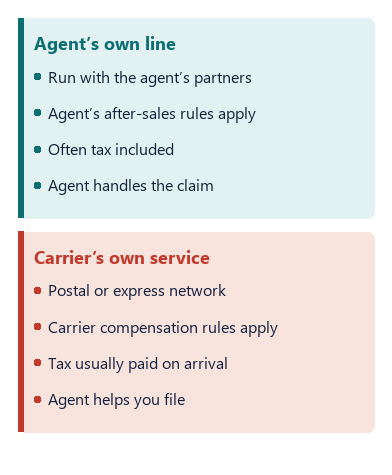
Mulebuy's August 2026 shipping page split its lines in two. Self-operated lines were run with its partners and handled under Mulebuy's own after-sales standard. Other lines were the carriers' own services, and compensation followed the carrier's policy, with Mulebuy helping to file. Its July 2026 notices added an EU line with duties covered, for parcels up to 25 kilograms, quoted at 12 to 18 days.
Other agents label lines differently but face the same split. Before choosing, look for the words tax included, the weight range, the delivery estimate and the compensation rule, and copy the line name onto the parcel card exactly. If a claim is needed, the line name is the first thing support will ask for.
Tracking that stops moving
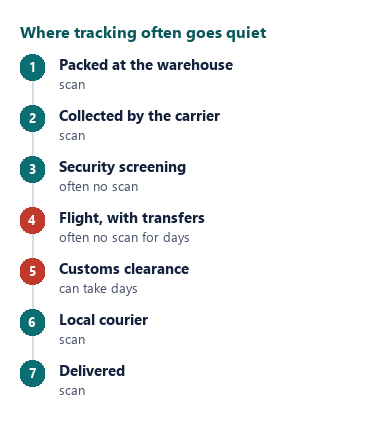
International tracking goes quiet for days at a time, and most of the time nothing is wrong. Mulebuy's shipping page listed the stages: packing at the warehouse, collection by the carrier, security screening, flight booking, the flight itself with possible transfers, the airport center, customs clearance, the local courier and delivery. Several of those stages produce no scan at all.
A stalled tracking page is not the same as a lost parcel. Mulebuy's blog put it bluntly in July 2026: “Tracking that has not changed for a few days does not prove a loss.” A carrier has to confirm it. Agents and carriers have their own timelines for declaring a parcel lost, and they are measured in weeks.
Write the last tracking update and its date on the parcel card whenever you look. If you contact support, that line answers their first question before they ask it.
Customs and duties, briefly
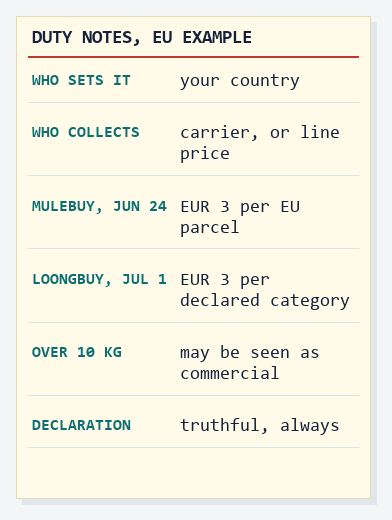
Import duties and taxes are your own country's business, not the agent's. On ordinary lines the carrier collects them on arrival; on tax-included lines the price already covers them. Thresholds, rates and handling fees vary by country and change over time.
Two recent changes affected European buyers. Mulebuy began charging a flat 3 euro per parcel to EU addresses from June 24, 2026, and LoongBuy announced on June 24, 2026 that from July 1 the EU's exemption for low-value parcels was replaced by a fixed 3 euro duty counted per declared category, adding up for parcels with several categories.
Weight and quantity can also change how a parcel is treated. Mulebuy's weight page noted that parcels over 10 kilograms or holding many identical items were more likely to be classed as commercial. If you are building a large parcel, that is worth knowing before you pack it, not after.
This site does not give advice on declarations. Declare goods truthfully, as the carrier and your country require.
The first evening with the parcel
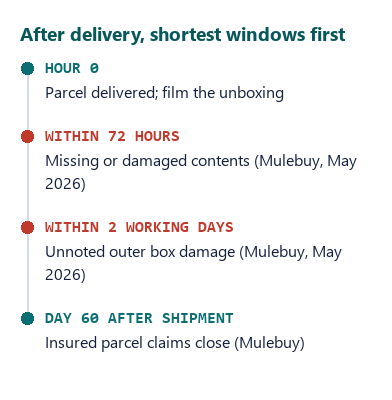
Reporting windows after delivery are counted in hours and working days, so the first evening matters. Film the unboxing from the sealed parcel onwards, with the label in shot. Check each item against its card before you throw any packaging away.
Mulebuy's May 2026 help center gave the shortest windows we have seen written down: damaged outer packaging that was not noted with the courier had to be reported with photos within two working days, and missing or damaged contents within 72 hours. An insured parcel gave you 60 days from shipment to claim. Agents open today set their own limits; read them before the parcel lands, not after.
Close each card with the delivery date and a short note on condition. If you file a report, write the date and the reference number on the parcel card, and keep the video with the photos.