Picking the seller and the listing before a catalog find becomes an order
The seller and the option you choose decide most of what arrives. This page covers what a listing reveals, what to copy onto the card, and the mistakes to catch before paying.
Reading the seller off the listing page
You rarely talk to a seller directly; the agent does that. So how to judge a seller comes down to reading what the listing already shows, and writing the useful parts onto the card.
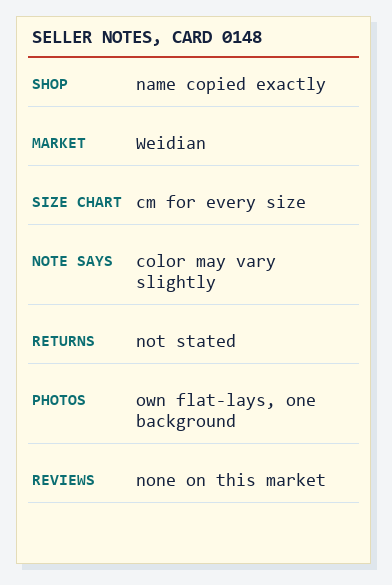
- The shop name, and whether it stays the same. A shop name that matches across the listing, the photos and the pre-purchase note is a good start.
- The pre-purchase note. Sellers use it for color variation, sizing advice, shipping times and return limits. A note that says returns are not accepted is worth knowing before you pay.
- The size chart. A seller who publishes measurements in centimeters for every size is easier to buy from than one who lists only letters.
- Photos the seller took. Real flat-lays and hanging shots, with the same background across the set, suggest the seller has the stock in hand.
- Reviews where the market has them. Taobao listings often carry buyer photos. Many Weidian shops have few or none, which is common and not in itself a warning.
Write the shop name on the card exactly as shown, including any Chinese characters. It is your way back to the same seller.
The shop name hidden in a photo
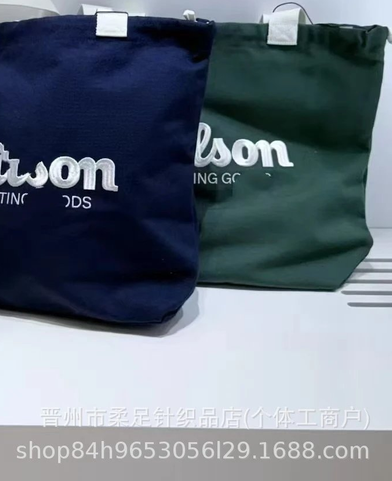
Sellers often stamp their shop name across their photos to stop other shops copying them. The photo here, from a tote bag entry in the catalog, carries two lines of watermark: a shop name ending in the words for an individually owned business, and a shop address on 1688.
That watermark tells you two useful things. The 1688 address says the photos started life on a wholesale market, where shops often sell in quantity and the retail listing you are looking at may come from a reseller using the factory's pictures. The shop name gives you a second way to find the same goods if the listing you saved disappears.
A watermark is a clue, not proof. Photos are copied between shops all the time, watermark included, and the shop selling to you may not be the one in the stamp. When the watermark and the listing's shop name differ, write both on the card.
The same goes for text burned into product photos: sizes, colors and Chinese captions. Read them; they are often the clearest statement of what the photo shows.
Choosing the listing and the option
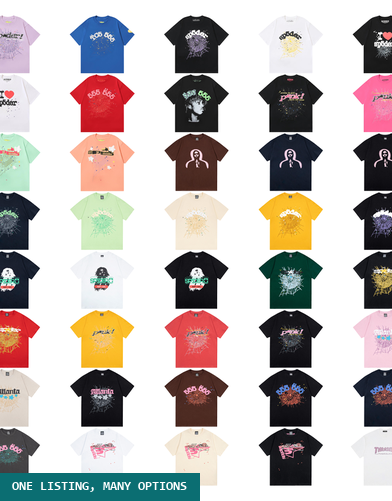
Here is how to choose a listing when several sell what looks like the same item. Compare them on the things that end up on your card, not on the cover photo: the option list, the size chart, the price for your option, and whether the seller's own photos show the exact color you want.
Collections need extra care. A single listing may sell ten styles under one cover photo, each picked from an option list written in Chinese. Copy the option text exactly, and if the option names are vague, such as a number or a letter, find the photo the seller has matched to it and note its position in the gallery.
Price per option is the other trap. The price on a catalog shelf is usually the cheapest option, and the size or color you want may cost more. Check the price beside your option before you put it on the card.
When two listings look identical, the one with a full size chart in centimeters and its own photos is usually the safer choice, even at a few yuan more. Search the catalog with your saved words, for example wide leg jeans, to line them up.
Size charts and the measurement worth keeping
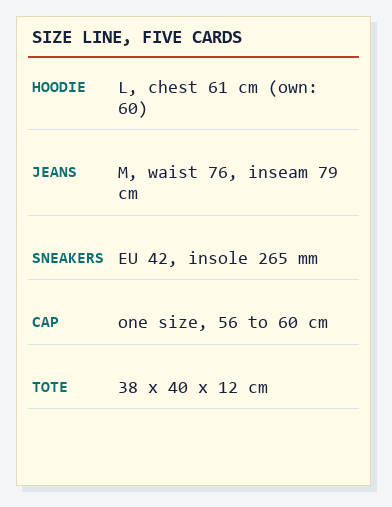
Letter sizes on Chinese listings run to their own scale, and the same letter can differ between two shops. The measurement in centimeters is what travels between listings, so pick one per kind of item and keep it on every card:
- Tops, hoodies and jackets: chest width, measured flat from armpit to armpit.
- Jeans and trousers: waist and inseam.
- Sneakers: insole length in millimeters, if the seller lists it.
- Caps: the head size range.
- Bags: width, height and depth.
The quickest way to choose a size is to measure a piece you already own that fits well, the same way the chart measures, and pick the size whose number is closest. Write your own garment's figure next to the chart's on the card. When the warehouse photos arrive, a ruler in the shot lets you compare one more time before the item ships.
Mistakes to catch before you pay
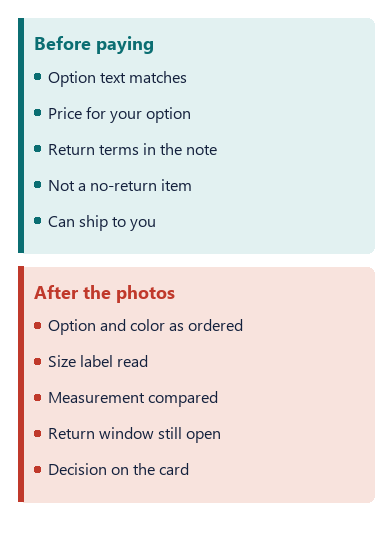
Most problems with an agent order start before the money moves. Check these before you pay:
- The option you picked at the agent matches the option text on your card, character for character.
- The price for that option matches, or you know why it differs.
- The seller's note does not rule out returns for this item, if a return might matter to you.
- The item is not on the list most agents cannot return: custom-made pieces, underwear and socks, items you asked to be unpacked or have their tags removed, second-hand goods.
- The item can ship to you. Batteries, liquids, powders and magnets limit the lines available; perfume and power banks are the usual surprises.
- The stock is real. A stock figure online is the seller's claim; the agent's purchase confirms it.
Avoid paying for several sizes at once to be safe unless the return terms allow it; each unused size costs domestic return shipping and often a service fee.